When planning your NEET last week revision, it is not the time to open new chapters or dive into complex reference books. It is the time for consolidation, high-yield targeting, and active recall. Your strategy right now should focus purely on maximizing your return on time invested.
Here is an in-depth breakdown of the most critical, high-weightage topics across Biology, Physics, and Chemistry that you must review in these final days.
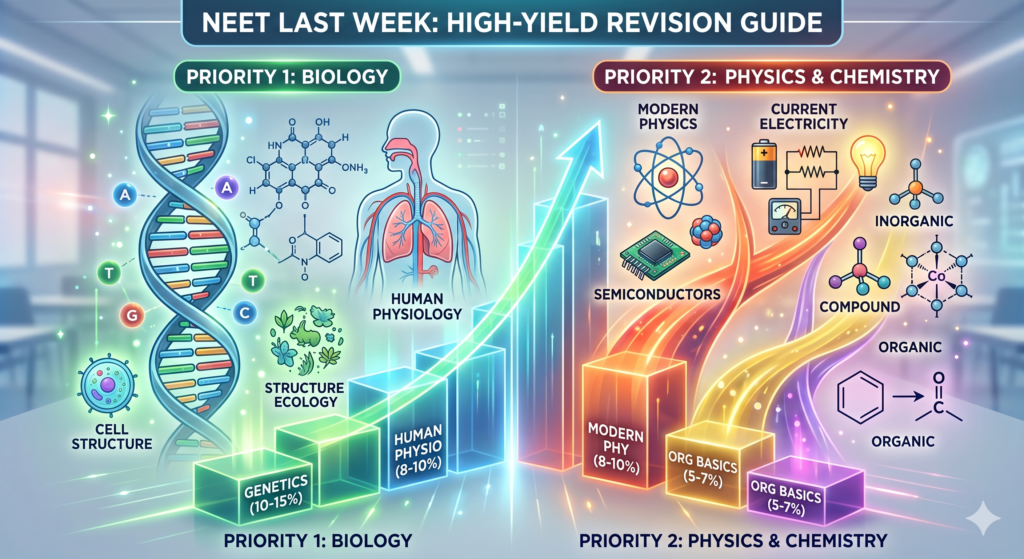
🧬 Biology (360 Marks) — The Ultimate Priority
Biology accounts for exactly half of your total score. In this final NEET last week revision, NCERT is your only textbook. Do not just read the text; actively review the diagrams, labeling, summary paragraphs, and the introductory scientist biographies.
Focus heavily on these high-yield areas:
- Genetics & Evolution: This is a heavy-hitter. Specifically focus on the Molecular Basis of Inheritance and Principles of Inheritance. These two chapters alone often account for 10–15 questions. Ensure you are clear on pedigree analysis and genetic disorders.
- Biotechnology: Both Principles & Processes and Applications. These are relatively short chapters but yield a disproportionately high number of questions (8–10 combined). Be crystal clear on restriction enzymes, cloning vectors, and PCR steps.
- Human Physiology: Prioritize Chemical Coordination, Breathing & Exchange, and Body Fluids. Make sure you know the exact action mechanisms of hormones and the pathways of the heart and lungs.
- Plant Physiology: Focus on Photosynthesis (C3, C4 pathways) and Respiration (Glycolysis, Krebs cycle). These are conceptual and highly testable.
- Ecology: Ecosystem and Biodiversity are straightforward, memory-based chapters. Review the data, charts, and environmental acts/dates.
- Cell Structure & Function: A foundational unit that usually guarantees 5–6 direct questions. Pay special attention to cell cycle stages and chromosomal changes during mitosis/meiosis.
⚛️ Physics (180 Marks) — High Return on Time
Physics in the final week should be about formula revision and recognizing standard problem models. Focus on formula-heavy chapters where questions are often direct applications rather than complex, multi-step derivations.
- Modern Physics & Semiconductors: This includes Atoms, Nuclei, Dual Nature, and Semiconductors. This block is highly scoring, heavily formula-driven, and consistently yields 8–10 questions. Be rock-solid on logic gates, Bohr’s model, and photoelectric equations.
- Current Electricity: Always a heavy hitter (3–5 questions). Practice circuit analysis, resistor color codes, and specifically the measuring instruments (potentiometer, meter bridge, galvanometer conversions).
- Thermodynamics & KTG: High priority because the concepts overlap significantly with Chemistry, giving you double the benefit for your time. Focus on the standard gas laws, work done in different processes, and engine efficiency.
- Optics: Focus on Ray Optics and optical instruments. Practice the sign conventions thoroughly—this is where most silly mistakes happen.
- Gravitation & Electrostatics: Review the parallel formulas between these two chapters (e.g., force, field, potential) to save memorization time.
🧪 Chemistry (180 Marks) — The Core Scoring Areas
Balance your revision across the three branches, focusing on these main pillars:
- Inorganic Chemistry: NCERT is the bible here.
- Chemical Bonding & Coordination Compounds: These are the most critical inorganic chapters. Focus on VSEPR theory, hybridization, MOT (bond order tricks), and isomerism/crystal field theory.
- p-block and d & f-block: Focus on trends, exceptions (like ionization energy anomalies), and the preparation/properties of KMnO4 and K2Cr2O7.
- Organic Chemistry: * GOC & Hydrocarbons: General Organic Chemistry (reaction mechanisms, stability of intermediates like carbocations/carbanions, acidic/basic strength) is the key to solving most organic questions.
- Carbonyl Compounds (Aldehydes, Ketones, & Carboxylic Acids): Review all named reactions (Aldol, Cannizzaro, Ozonolysis) and reagent functions.
- Biomolecules & Polymers: Pure memorization. Don’t skip them; they offer free marks.
- Physical Chemistry: * Electrochemistry, Kinetics, & Solutions: Focus on direct formula applications. Review the Nernst equation, Faraday’s laws, integrated rate equations, and colligative properties (especially involving the Van ‘t Hoff factor).
🧠 Final Week Action Plan & Exam Strategy
- Stop Solving New Material: Rely entirely on your short notes, formula sheets, and highlighted NCERTs.
- Review Your ‘Mistake Notebook’: Go through the mock tests you’ve taken over the last few months. Look at the questions you got wrong. Fixing those specific blind spots will boost your score more than reading a new chapter.
- Sync Your Body Clock: Sit at your desk and solve previous year papers (PYQs) or mock tests strictly between 2:00 PM and 5:20 PM. Train your brain to be at its absolute peak alertness during the actual exam window.
- Master the OMR: Practice bubbling your OMR sheets accurately. Do not leave all the bubbling for the last 15 minutes. A good strategy is to bubble after completing each subject section.
- Prioritize Sleep & Nutrition: A tired brain cannot recall complex formulas. Ensure you are getting 7–8 hours of sleep leading up to the exam.
Stay calm, trust your preparation, and focus on execution. Good luck!